A rescue dog named Rosie has become the first dog in history to receive a personalized mRNA cancer vaccine — designed using AI tools by her owner, an Australian tech entrepreneur with no formal biology training. By March 2026, her tumor had shrunk by 75%.
This is that story.
Meet Rosie
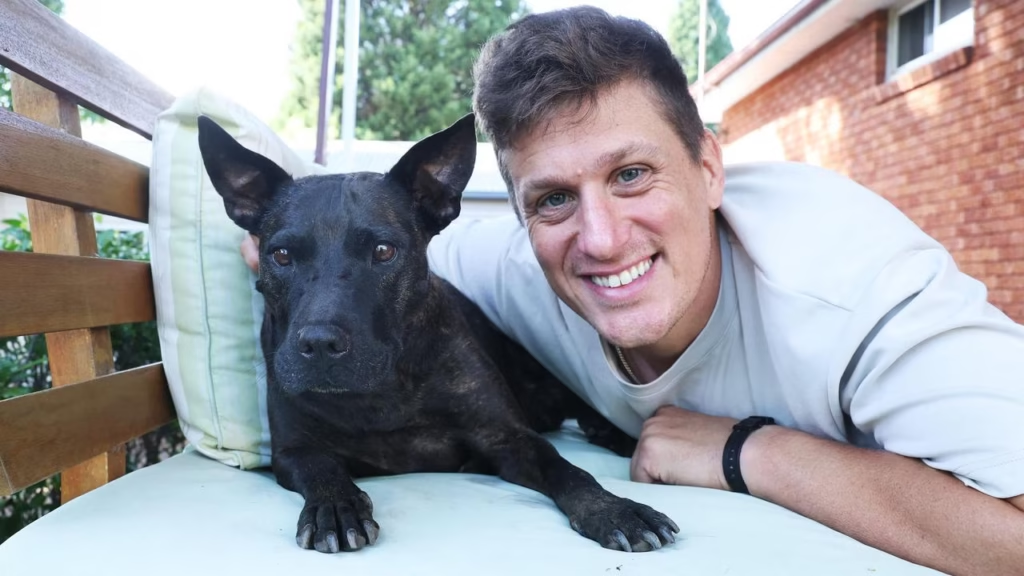
Rosie is a Staffordshire Terrier–Shar Pei mix adopted from a Sydney animal shelter in 2019 by Paul Conyngham. Like many rescue dogs, she arrived with an unknown past and an eager energy that made her impossible to overlook.
After coming home, she became Conyngham’s constant companion — running through fields, chasing rabbits, demanding attention in the way only a shelter dog who finally found her person can.
When she was diagnosed with cancer in 2024, that same bond drove Conyngham to do something no one had ever attempted before.
The man who refused to give up
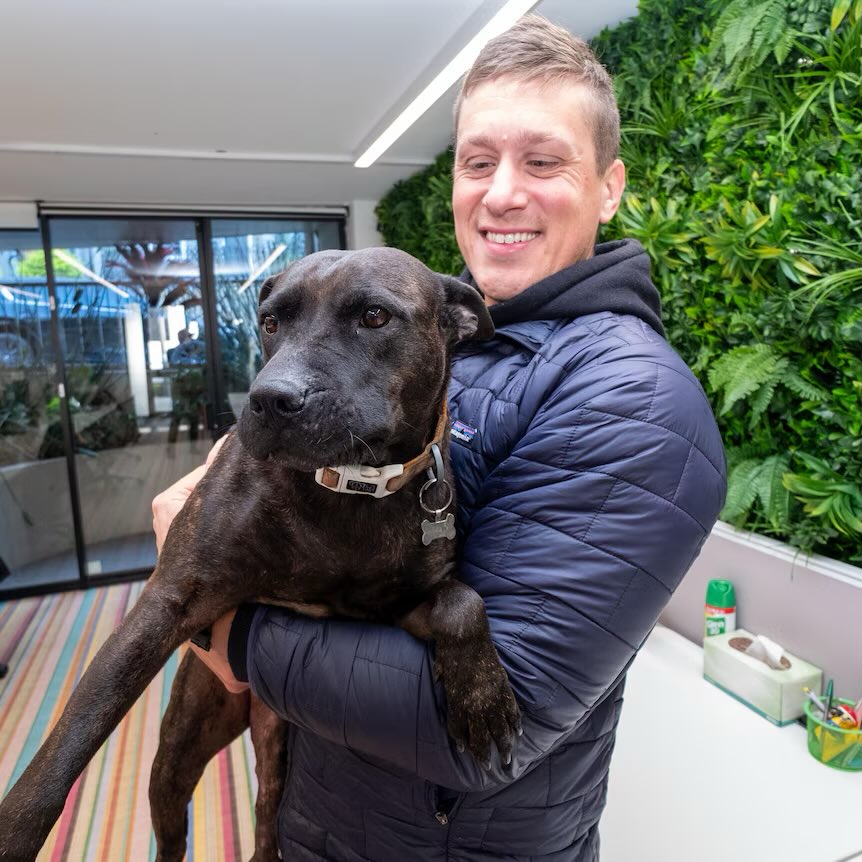
Most people, when told their dog has a life-threatening cancer that has survived both chemotherapy and surgery, would grieve and prepare for the worst. Paul Conyngham is not most people.
An electrical and computing engineer and tech entrepreneur — co-founder of Core Intelligence Technologies and a former director of the Data Science and AI Association of Australia — Conyngham had the tools, the mindset, and the stubbornness to try something completely new.
What followed was months of late nights, a 100-page ethics application, two 10-hour drives, and a scientific breakthrough for a rescue dog who just wanted to chase rabbits.
A diagnosis no dog owner wants to hear
Rosie was diagnosed with mast cell cancer in 2024. Conventional treatment did what it could — surgery removed what it could reach, chemotherapy slowed the disease. But the tumors kept coming back.
The largest, sitting on Rosie’s leg, grew to roughly the size of a tennis ball. Faced with running out of options, Conyngham did what any good engineer would: he started asking better questions.
How he did it
Conyngham had no formal biology background. What he had was a systematic mind, powerful AI tools, and a dog he wasn’t willing to lose.
Here’s the path he actually took — including the parts most news articles leave out:
-
Asked AI for a roadmap. ChatGPT suggested immunotherapy and pointed him toward UNSW’s Ramaciotti Centre for Genomics — a world-class facility in Sydney.
-
Sequenced Rosie’s entire genome. He paid $3,000 to have Rosie’s DNA and tumor samples sequenced, then ran the data through custom machine-learning pipelines to identify the exact mutations driving her cancer.
-
Used DeepMind’s AlphaFold to map the cancer proteins. AlphaFold — Google DeepMind’s protein-structure AI — helped him visualize the 3D shape of Rosie’s mutated proteins and identify how the immune system could target them.
-
Pivoted to mRNA after a drug was refused. His initial drug option was rejected by the manufacturer. He pivoted to mRNA vaccine technology — the same platform behind COVID-19 vaccines — and connected with UNSW’s RNA Institute.
-
Spent 3 months on a 100-page ethics application. This is the part most stories skip. Conyngham spent 3 months preparing a 100-page ethics submission, dedicating 2 hours every single evening to get regulatory approval to proceed.
-
A custom vaccine was synthesized. UNSW’s RNA Institute used his half-page formula to create a fully personalized mRNA vaccine tailored to Rosie’s specific tumor mutations. No dog had ever received one before.
-
Drove 10 hours — twice. Professor Rachel Allavena at the University of Queensland’s School of Veterinary Science administered the vaccine. Rosie received her first dose in December 2025, and a booster in February 2026.
| 75% | $3,000 | 100 pages | First ever |
|---|---|---|---|
| Tumor shrinkage | DNA sequencing cost | Ethics application | Dog to receive a personalized mRNA cancer vaccine |
The result that stunned scientists
By March 2026, the tennis ball-sized tumor on Rosie’s leg had shrunk by approximately 75% — confirmed during Conyngham’s appearance on Australia’s Today Show.
A senior researcher at UNSW’s Ramaciotti Centre put it plainly: “A non-biologist used a stack of AI tools to do in months what would have taken a research team years.”
She’s back to her normal, ridiculous self: chasing rabbits, demanding attention, and probably stealing socks.
Important context: Not every tumor responded to the first vaccine. One of Rosie’s tumors didn’t shrink, and the research team is already sequencing it to design a second, targeted vaccine. This is a promising treatment — not yet a complete cure. That’s what makes the ongoing research so important.
Why this matters beyond one dog
One UNSW professor asked a question that stopped the room: if we can do this for a dog, why aren’t we rolling this out to humans with cancer?
Rosie’s case is now actively informing cancer research at UNSW. mRNA cancer vaccines are already being tested in human trials — and Rosie just moved that conversation forward in a very real way.
This is “citizen science” — and it’s changing everything
UNSW researchers have given a name to what Conyngham did: citizen science. The idea that someone outside a formal research lab — armed with AI tools, domain expertise, and relentless determination — can contribute to cutting-edge medical science is genuinely new territory.
AlphaFold has quietly become one of the most important scientific tools on the planet. And mRNA technology, once the workhorse of COVID-19 vaccines, is now being pointed directly at cancer.
Rosie was the first dog in history to receive a fully personalized mRNA cancer vaccine. She will not be the last.
What this means for your dog
We’re not suggesting you fire up ChatGPT the moment your vet delivers bad news. Conyngham spent tens of thousands of dollars, worked closely with world-class researchers, navigated a serious regulatory process, and brought a very specific engineering background to the problem.
But Rosie’s story is a reminder that the tools available today are unlike anything that existed a decade ago. If your dog is ever diagnosed with something serious, the most important thing you can do is find a vet you genuinely trust, ask every question you have, and push for second opinions without hesitation.
Fierce love for a dog, combined with the right expertise, can move mountains. Even the ones inside a cancer laboratory.
If Rosie’s story moved you, you might also love the story of Hachiko — a dog whose loyalty became a lesson the whole world still remembers. More stories like this live in our dog stories collection.
Share Rosie’s story with every dog parent you know. It deserves to travel.